Summer's almost upon us again, so I thought I'd make a list of my ten favorite summer jams.
1)"Summer" - War
For me, this is the ultimate summer jam. It has a nice breezy vibe goin' on. It's a really soothing jam, one you can just kick back and listen to while drinking a beer or just chillin'. It's also a great song to listen to while cruising on a warm summer day. Beautiful song.
This song always reminds me of a bright summer day when I hear it. It's a timeless pop/soul classic penned by Maurice White and Al McKay from Earth, Wind & Fire, and The Emotions' voices are in top form on this song.
This song always puts me in a summer mood, no matter what time of year it is. It's one of the happiest jams I've ever heard and is my favorite ELO cut.
I like how Stevie fuses reggae with his own unique sound on this song. An excellent summer jam and a great addition to Stevie's massive catalog of hits.
This brilliantly crafted pop song sounds like hordes of people hitting the beaches in Southern California during the summer. Brian Wilson's stellar songwriting chops are in clear evidence on this classic.
Rap legend Tupac Shakur collaborated with beat maestro Dr. Dre and funk master Roger Troutman for this prodigious rap anthem. In 1995 people all over Los Angeles were bumpin' this track in their cars. It sort of became the LA theme song of '95. It's a great song to blast out of your car while cruising, especially during the summer.
An infectious, hook-filled summer classic. In my view, a list of great summer tunes wouldn't be complete without this song on it. The song pulls the listener in from the very first note.
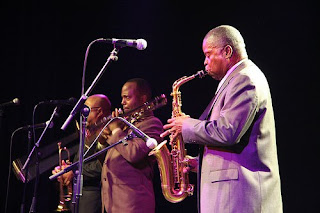
Maceo Parker's name is synonymous with funk. When I hear his name, I immediately think of greasy, raw, uncut funk. I can say without exaggeration that Maceo is the funkiest sax player on the planet. He was James Brown's go-to guy on some of the funkiest records ever recorded. When a groove had reached its apex of funkiness, James would often call for Maceo to bring one of his roof-burning sax solos to the mix. And miraculously Maceo would make the groove even funkier.
He consistently delivered massive doses of funk on each of his solos. He could improvise solo after funky solo, with each one being funkier than the last. It's no wonder that Maceo was the most showcased musician in James Brown's rotating squadron of funky players. My brother once told me that when he was little, he thought James was shouting, "Mercy!" when he was calling for Maceo, which is fitting because Maceo did indeed bring some mercy to the mind and soul with his incredibly funky solos.
Maceo also had a long and productive tenure playing with Parliament/Funkadelic as a member of the Horny Horns. He played on some of Parliament's biggest hits and contributed solos to iconic cuts like "Flashlight" and "P-Funk (Wants To Get Funked Up)." He also played on all four Bootsy's Rubber Band albums, three of which (Strecthin' Out In Bootsy's Rubber Band, Ahh... The Name Is Bootsy, Baby! and Bootsy? Player of the Year ) are undisputed funk classics.
In addition to The Godfather and The Funk Mob, Maceo has recorded with a cavalcade of prominent artists and bands, including Keith Richards, Red Hot Chili Peppers, The Dave Matthews Band and Living Colour. Maceo has also recorded with his Royal Badness himself, Prince, and played some dates on Prince's 21-night stint at the O2 Arena in London in 2007.
Maceo has also brought the funk on a number of solo projects, including Roots Revisited,Mo' Roots, and For All The King's Men. And the MTV crowd became aware of him when he was featured in Deee-Lite's cheerfully goofy and slighty wigged-out video for the infectious hit song "Groove Is In The Heart" in which his fellow P-Funk alum Bootsy Collins also appeared.
Maceo was born in Kinston, North Carolina in 1943 and hailed from a musical family. His father played drums and piano, and both parents sang in church. His brother Melvin played drums and his brother Kellis trombone. In 1964, Maceo and his brother Melvin joined James Brown's band.
Nikka Costa is one red-hot funky mama. If you cross Janis Joplin with Chaka Khan and throw in some Prince and '70s funk diva Betty Davis, you'll get Nikka Costa. She's a massively funky artist as well as a magnetic performer. She first came to national attention in the U.S. in 2000 with the irresistible funk/soul cut "Like A Feather," which was featured in a Tommy Hilfiger television advertising campaign. The song's video received heavy rotation on popular music video channels, such as MTV and VH1. And she also got a lot of play with the Sly Stone-ish track "Everybody Got Their Something," which was also featured in several advertising campaigns. "Like a Feather" peaked at #53 on the UK Singles Chart.
After watching Nikka's "Like A Feather" video and some of her live performances, I was positive that she was set for big things in the U.S. Her performances are ballsy, sweat-soaked emotional blowouts much in the tradition of Janis Joplin, but funkier. Her sound is a fusion of funk, blues, rock and soul, with a little dash of hip hop thrown in. Nikka didn't break big in the U.S. like I thought she would. I think she was just too raw and pure an artist to fit nicely into a safe marketable package for mass consumption, especially at a time when prepackaged pop artists like Britney Spears and *NSYNC were topping the charts.
Nikka has great musical lineage. Her father was acclaimed producer/musician/arranger Don Costa. While growing up, she met a slew of entertainment legends, including Sly Stone, Sammy Davis, Jr. and Quincy Jones. She was also Frank Sinatra's goddaughter. So music has pretty much always been a big part of Nikka's life, and she started singing and performing at a very young age. Her first gig was opening for Don Ho in Hawaii at the age of five. Although she hasn't established a huge following in the U.S., she has enjoyed much success in other parts of the world. She has released albums throughout Europe, Israel, Australia and South and Central America, most of them achieving platinum status. And she has scored number-one hits in Italy, Germany and France. Also, in addition to singing, Nikka plays several instruments, including the drums, guitar and keyboards.
Nikka oozes funk and soul from every pore on her records and live performances. She possesses the pure, raw soul of funk and rock legends of the'60s and '70s. Nikka was born in the wrong era, as she has more in common with soul and rock artists from the past than she does with her musical peers.
Creating a follow-up to one of the most successful and critically acclaimed albums of all time must have been an extremely daunting task even for someone as talented as Michael Jackson. There would be the inevitable comparisons to Thriller, and even if it sold well, it would still be considered a disappointment if it didn't sell in astronomical numbers and receive widespread critical acclaim. MJ set the bar extremely high with Thriller, and to surpass it would take close to a miracle. I guess after the unprecedented success of Thriller, MJ did indeed believe in miracles, as he wanted its successor to move 100 million units and have critics laud it as a magnum opus, grabbing a truckload of awards in the process. MJ was a pure and genuine artist, but numbers and awards still meant a lot to him. Thus, the pressure was on the pop/soul superstar to produce another masterpiece that sold like gangbusters.
Five years after the release of Thriller, MJ finally dropped Bad in late August of 1987. And while the album sold incredibly well, it didn't move near the numbers MJ had hoped for. And on top of that, critics weren't falling over themselves to praise it as they had Thriller. As expected, some have dubbed Bad a disappointment, both commercially and artistically. It's a testament to MJ's massive popularity that an album that garnered five number-one singles and sold 35 million copies worldwide could still be considered a commercial disappointment. While most critics agreed that it was a top-notch effort, very few, if any, said it was on the same exceptional level as Thriller.
In my opinion, Bad is a very strong album, and I never get bored of listening to it, even upon repeated plays. While the album lacks world-beating classic cuts like "Billie Jean" and "Beat It," it's just as enjoyable a listening experience as its predecessor. The key to really getting into this album is to put Thriller out of your mind and approach it as a stand-alone musical statement. Approach it fresh with no unrealistic expectations, and you'll definitely enjoy it more.
One of the things that I like most about Bad is that it is made up mostly of MJ's compositions. He wrote and composed nine of the album's 11 songs. By comparison, he wrote only four songs for Thriller. I've always thought MJ's songwriting skills were underrated. He's generally praised for his singing, dancing, and overall gifts as a performer, but people often forget that some of the greatest songs in his discography were penned by him. For Bad, MJ once again tapped Quincy Jones to produce. Jones had produced both Off The Wall and Thriller--two amazing albums that effectively showcased MJ's talents. Thus, it wasn't surprising that he brought in Jones again in hopes of recapturing some of the magic of the previous two albums.
Anyway, let's get down to the songs themselves. The album kicks off on a funky note with "Bad." The song is sort of an homage to MJ's idol/mentor James Brown ("I got soul, and I'm super bad!"), as it has a grittier and funkier sound than most of MJ's songs up to that point. To be sure, the song is not nearly as funky as Brown's combustible grooves, but it's pretty funky for MJ, a nice and unexpected departure from the more smooth R&B/pop cuts off Thriller. The Jackson-penned song has a relentless and menacing bass line, and he sings the verses in a husky growl and spits out "Shamone" with the raw soul of a chitlin' circuit blues shouter. Legendary jazz organist Jimmy Smith serves up a nasty solo, raising the song's funk quotient considerably. Smith's solo is seamlessly followed by an excellent synthesizer solo from keyboardist extraordinaire Greg Phillinganes, who was MJ's musical director on his Bad and Dangerous world tours.
"Bad" is followed by the shuffling "The Way You Make Me Feel." The song, written and composed by MJ, is an infectious slice of pop/soul. It is another example of MJ's unfailing ear for great melodies. It's one of those songs that people love to sing along with. The next cut, "Speed Demon," is a solid groove. The song starts with an engine revving up, and MJ sings the verses in the same gritty, husky voice that he used in "Bad." Also, as in "Bad," MJ shoots for a more funky sound with this song. And the lyrics are pretty interesting. Some critics have said the lyrics have a Freudian component, claiming the song is about MJ's superego putting his id in check: "Pull over boy, and get your ticket right." This song was written and composed by MJ.
"Liberian Girl" is the first mellow jam on the album. The song has a slight island flavor to it, and MJ performs it with intense passion. The harmonies on the chorus sound amazingly warm. I don't know why this song didn't get more play. It was written and composed by MJ.
On "Just Good Friends," MJ duets with Stevie Wonder, and unfortunately, it's a bit of a disappointment. With two great talents at the helm, I expected much more than this light pop/soul fare. It should be noted that neither MJ nor Stevie contributed to the writing of this song, and perhaps that's why it sounds so bland. The spark and magic are simply missing from this track. It's just such a huge missed opportunity.
Side two opens with "Another Part of Me," a good uptempo song that advocates global unity. It was originally used for MJ's 3D-film Captain Eo, which was shown at Disney theme parks in the '80s and '90s. Next up is "Man in the Mirror," one of MJ's most well-known songs. Written by Siedah Garrett and Glen Ballard, the song's basic message is that before one can effectively bring about positive changes in the world around them, they must first look inside and better themselves. The song features some fiery, gospel-tinged singing by MJ, who receives strong support from The Winans and the Andrae Crouch Choir.
MJ goes from church to passionate romance with "I Just Can't Stop Loving You," a duet with Siedah Garrett. This song was the first single off the Bad album, and, for the life of me, I don't understand why he would choose such a bland song to kick off the album. It just sounds like your standard, by-the-numbers adult contemporary love song, nothing exciting or inspired about it. MJ usually comes up with such great melodies, but this is not one of them. Also, the lyrics are pretty sappy, even for this type of song. Garrett has a good voice, but brings nothing special to this track. This is the only song off Bad that I always skip.
MJ visits the decadent world of rock stars and groupies with "Dirty Diana" (MJ-penned). The song touches on some of the same themes as "Billie Jean." As in "Billie Jean," this song involves a predatory woman attempting to ensnare MJ in her web of sex, lies, and deceit. The song evokes an atmosphere of dread and despair. It is anchored by a slow, foreboding bass line with MJ singing in a plaintive fashion. Rock guitarist Steve Stevens contributes a blistering solo to the cut.
"Smooth Criminal" is another singular MJ-penned song with a really creepy subject matter: a home-invasion murder. The song has a rapid, driving bass line, and MJ sings his lyrics with power and intensity. He again shows his gift for melody with this song, especially on the chorus. The multi-overdubs of his harmonies on the chorus are goosebump-inducing. The song made it to number seven on the Billboard Hot 100 charts in the U.S. Only Michael Jackson could record a song about a woman being murdered in her home and have it make the top 10 on the pop charts.
The album closes with "Leave Me Alone," a keyboard-driven groove written by MJ. This marked the first time that he addressed in song what he felt was the media's unfair treatment of him. He would later record songs that were much more angry and confrontational toward the media, particularly on his HIStory album. This track has an excellent layered chorus arrangement and is one of his most underrated songs. It also has a terrific video, which has some great stop-motion and cutout animation. Directed by filmmaker/animator Jim Blashfield, the video won a Grammy for Best Short Form Music Video in 1990.
Bad is overall a stellar work, and people should view it on its own merits rather than compare it to Thriller. The only serious qualm I have with the album is the overuse of the synth bass on a lot of the songs. I know using the synth bass was popular at the time the album was released, but I wish they had used a real electric bass guitar on more of the songs. The overuse of the synth bass makes the album sound a little dated. Other than that, Bad is a joy to listen to. Bad also marked the last time that MJ and Quincy Jones worked together on an album. I had always wished that they had worked on one more project together.
As a someone who grew up on television and a lot of music, I paid close attention to the theme songs to TV shows. For me, a good theme song was very important, as it would capture my attention and pique my interest in the show. As an adult, I still pay attention to the music on television shows, and I'm more likely to watch a show I've never seen before if I like the intro music or song.
The theme song for "The Munsters"
This is my all-time favorite TV-show theme song. It's an infectious ghoulish groove with some surf guitar thrown into the mix to give it some rock flavor. And I really dig how the characters are introduced during the theme song: Granpa trying to bite Lily Munster's arm, Herman Munster clomping down the stairs, Eddie Munster getting annoyed at his Mom for fussing over him. Great stuff.
The theme song was written by Jack Marshall, who was a guitarist, conductor, composer, author and teacher. A veteran studio guitarist, Marshall played the guitar part himself, as he didn't trust anyone else to play it properly. He also scored the music for episodes of the show.
Additionally, Marshall composed music for other TV shows, such as "The Deputy," "The Debbie Reynolds Show," "Laredo" and "Have Gun, Will Travel." And Marshall also scored music for films. His film credits include Thunder Road, Tammy and the Millionaire, Kona Coast and Stay Away Joe. Marshall, who died at only 52 in 1973, lectured on guitar technique at the USC School of Music and wrote two books about guitar. The Munsters
"Way Down in the Hole" is the bluesy, gospel intro song to "The Wire," and it puts the viewer right in the mood for this gritty and riveting crime drama. The song was written by singer/composer/actor Tom Waits, and the version by The Five Blind Boys of Alabama was used for the intro to the first season. Waits' original version was used for the second season intro. In all, there have been five different versions of the song used for the intro, a different one for each of the series' five seasons. It's a shame the show didn't have a longer run.
"The Wire" is without a doubt one of the best series that HBO has ever aired. It's a compelling and intelligent look at the drug trade on the rough streets of Baltimore. The series gives a fascinating view of the situation shown from three different perspectives: the dealers, the police and the politicians.
Here is the intro to the first season with The Five Blind Boys of Alabama's soul-stirring rendition of "Way Down in the Hole":
And here's Tom Wait's searing original version used for the second-season intro:
Theme Song for "Spider-Man"
As a kid I was a comic book fanatic. I was obsessed with them and constantly bugged my parents to buy them for me. I only collected Marvel comics, because I thought their comics had the best artwork as well as the most interesting characters and stories. I still have about 300 Marvel comics from way back in the day. Spider-Man was, and still is, one of my favorite Marvel characters. His character was fairly complex for a superhero. He always seemed conflicted about his superhero status, and it was more of a burden for him than anything else. Plus, he never got the credit he deserved from the public for his efforts. He was treated like an outcast or pariah most of the time. Spider-Man was one of the early misunderstood superheroes, and that's what intrigued me so much about him. I must still have at least 35 Spidey comics stored away somewhere.
While the TV "Spider-Man" cartoon wasn't nearly as good as the comic book, I still watched it. What I liked most about the show was its theme song. I know it's kind of cheesy, but it still has a certain charm to it and is catchy as hell. It also has a great bridge. The song was written by Academy award-winning lyricist Paul Francis Webster and composer Bob Harris. The song has been covered by a number of musical artists, including The Ramones and Aerosmith.
The Ramones cover of the song:
"The Rockford Files" Theme Music
Even if it didn't have any association with the show, I still would have noticed the theme to "The Rockford Files" as being a great piece of music. The music sounds rugged like the protagonist Jim Rockford but also has an easygoing vibe that also fits Rockford's character. The harmonica part gives it a down-home feel. And the Moog synthesizer provides a nice balance to the harmonica, a creative fusion of old-school and new technology. Back when the show first aired in 1974, the use of a synthesizer on a television series theme song was pretty new.
Producer/musician/composer Mike Post co-wrote the theme with longtime collaborator Pete Carpenter. Post is one of the most successful and prolific composers in television history and has written memorable melodies to numerous hit shows, including "Hill Street Blues," "L.A. Law" and "NYPD Blue." He has won five Grammys and an Emmy for scoring television theme music.
Carpenter was a jazz trombonist, arranger and veteran of television theme song scoring. He began his musical partnership with Post in 1968, which lasted until his death in 1987. The two scored more than 1800 hours of television music together and collaborated on hugely popular shows such as "Magnum, P.I.," "The A-Team" and "Hunter." The two won a Grammy for "The Rockford Files" theme in 1975. The duo also composed music for film, including Vanishing Point and Rabbit Test.
During my visits to youtube, I've come across many talented musicians and singers showcasing their skills in hopes of reaching a wider audience, but none have stood out more to me than a musical duo known as Pomplamoose. Pomplamoose is made up of musician/songwriters Jack Conte and Nataly Dawn, who are also a couple. Jack is a multi-instrumentalist, songwriter and filmmaker who plays more than 15 instruments. Nataly is a singer, composer, bassist, pianist and guitarist. Their base sound is indie rock, but they jump around to a number of different styles.
The couple present interesting and quirky covers of popular songs as well as original compositions through a new medium called "VideoSong" that they upload on Youtube. Jack says at their website (http://www.pomplamoose.com/) that "VideoSong" can be defined by the following two rules: 1. "What you see is what you hear (no lip-syncing for instruments or voice)." 2. "If you hear it, at some point you see it (no hidden sounds)."
The duo infuse their VideoSongs with tons of humor and creativity, and I always end up smiling while watching them. Pomplamoose has played a few live shows and is unsigned, but I have little doubt that that will change soon. They are from Corte Madera, California.
Sly & The Family Stone took listeners on a sonic joyride on their fourth studio album Stand! (1969). The collection is bursting at the seams with innovative ideas, stellar musicianship and great songs. The band had recorded first-rate material prior to Stand!, but that still didn’t prepare listeners for this mind-blowing aural experience. Rock, funk, gospel, pop, soul, blues and psychedelia intersect on this raucous and exhilarating album. And what Sly & the Family Stone has created is truly a revelation.
First up is “Everyday People,” a pop-soul gem that advocates tolerance and racial unity. The song’s construction is very simplistic. It starts with basic piano chords that are accompanied by a bouncy bass line and a steady mid-tempo beat. The intro is so poppy and simple that is sounds like it could be the opening for a song by a ‘60s bubblegum pop group like the Archies or the Lemon Pipers—that is until Sly’s soulful, heartfelt vocals kick in. The song has a nursery-rhyme feel to it but with strong gospel overtones; the high point of the song is its swelling, gospel-tinged chorus. “Everyday People” immediately hooked radio listeners and became one of the band’s biggest hits.
And on the opposite end of the album’s musical spectrum, there’s “Sex Machine,” a bluesy, funky shuffle of a groove. Clocking in at 13:46, “Sex Machine” allows the band members to cut loose and show off their chops. Larry Graham burns down the house with a scorching fuzz bass solo, and Sly tears it up with some trippy talk-box scatting on guitar. Also, his brother Freddie holds it down with a nasty wah-wah guitar solo, and sax player Jerry Martini and drummer Greg Errico get their moments to shine.
The album also contains uplifting, inspirational songs, such as “Stand!” and “You Can Make It If You Try.” “Stand!” is a rousing civil rights and counterculture protest anthem with some great horn lines from Martini and trumpeter Cynthia Robinson. “You Can Make It If You Try” has a fun, circusy vibe with Sly contributing a terrific calliope-like organ solo.
And let’s not forget “Sing A Simple Song,” a massive hydrogen-bomb funk assault. It begins with an effect that sounds like a vacuum cleaner being turned on and then jumps into the song proper with sister Rose belting out an impassioned soul cry to kick off the proceedings. The song percolates with highly syncopated funk that never lets up. And check out the amazing vocal layering in the “do-ri-mi” section.
“I Want To Take You Higher” is a ferocious rock-funk track that rumbles with wild anarchic abandon. The song boasts wicked horn play by Martini and Robinson and a killer harmonica solo from Sly. The band raised the roof with this cut at Woodstock.
And we go from “Higher” to “Somebody’s Watching You,” a song with a sweet and innocent-sounding vocal arrangement that belies its slightly ominous lyrics. This track shows what an inventive and clever lyricist Sly was in his prime.
“Don’t Call Me Nigger, Whitey” is a freakafied, in-your-face attack on racism. Sly brings back the talk-box on this blistering funk-rock cut. Near the song’s end, it sounds like the band has grooved into orbit.
On Stand! Sly further demonstrated his mastery in the recording studio and his musical versatility. He wrote, composed, arranged, and produced every song on the album and pulled out all the stops with studio tricks and other sonic experiments. This album proved without a doubt that Sly & The Family Stone were one of the baddest, most innovative bands of any era in rock or soul music.